
The Federal Government has released draft legislation proposing a 30% minimum tax on discretionary trusts from 1 July 2028. The changes are not yet law, but they could have a significant impact on families and business owners who use trusts.
Currently, family trusts can distribute income to family members who may pay less tax, but under the proposed changes, trust income would generally be taxed at a minimum of 30%, even if the family member normally pays a much lower tax rate.
The good news is that existing trusts may have a choice.
A trust could continue operating as a discretionary trust, allowing the trustee to determine how income is distributed among eligible beneficiaries each financial year.
However, this flexibility could come at a cost.
The proposal describes a minimum tax rate of 30%, potentially affecting the tax efficiency of distributions.
Individual beneficiaries might receive a credit for tax already paid by the trust, while distributions to corporate beneficiaries could be treated differently.
For families and businesses that regularly distribute trust income to companies, this could have significant tax implications.
An alternative described in the proposal would allow existing discretionary trusts to elect to fix their beneficiaries and their respective entitlements to income and capital.
For example, a family trust might nominate:
Parent 1: 50% entitlement
Parent 2: 50% entitlement
In exchange, the trust could potentially avoid the proposed minimum 30% tax treatment.
However, the trade-off would be substantial: the trust would largely surrender its ability to vary distributions in future years.
Departing from the nominated arrangements could also trigger adverse tax consequences, including potentially higher tax rates and restrictions on future elections.
One of the main advantages of a discretionary family trust is its flexibility.
For example, a trustee may decide to distribute more income to one spouse in a particular year or make distributions to eligible adult children as their financial circumstances change.
This flexibility can be valuable for family tax planning, business succession and wealth management.
Under the fixed-entitlement option described in the proposal, families could lose much of that flexibility.
There would also be important considerations for future generations. If beneficiaries and their entitlements had to be permanently nominated, including children or grandchildren in future distributions could become more complicated.
These issues highlight why any proposed changes to discretionary trusts would require careful consideration.
The proposal also describes a potential transitional rollover period between 1 July 2027 and 30 June 2030.
This would potentially allow eligible discretionary trusts to transfer certain assets into alternative structures, such as companies or fixed trusts, without immediately triggering capital gains tax.
However, restructuring a trust is rarely straightforward.
Even where capital gains tax rollover relief is available, other matters may need to be considered, including:
State-based transfer duty
GST implications
Legal and administrative costs
Asset protection
Succession planning
The long-term tax consequences of the new structure
A restructuring decision should always be based on the family’s broader circumstances rather than tax considerations alone.
There is no reason to rush into restructuring an existing family trust based on unverified legislative proposals.
Nevertheless, reviewing your trust arrangements periodically is good practice, particularly where your family circumstances, business activities or financial objectives have changed.
Some useful questions to consider include:
How important is the flexibility to distribute income among different family members?
Have trust distributions remained relatively consistent, or do they change each year?
Does the trust regularly distribute income to a corporate beneficiary?
Are there children, grandchildren or other family members you may wish to benefit in the future?
Would a different ownership structure better support your long-term objectives?
Family trusts can offer significant advantages, but their effectiveness depends on the circumstances of each family or business.
If changes of the kind described above were ever introduced, the key consideration would not simply be how to minimise tax. It would also be about balancing tax efficiency, flexibility, asset protection and long-term family planning.
At All Square Accountants, we help families and business owners understand their trust structures, review their tax planning strategies and make informed decisions about their financial future.
If you would like to review your existing family trust arrangements, contact our team to discuss your options.
If you’re bringing on a new accountant, or changing what your current one is allowed to do for you, the ATO now needs you to approve that link yourself. It’s called client-to-agent linking, and it exists for a good reason: it stops anyone attaching themselves to your ABN without your say-so.
The catch is that we can’t do this step for you. You have to nominate us from your own ATO Online services for business account. Here’s exactly how it works.
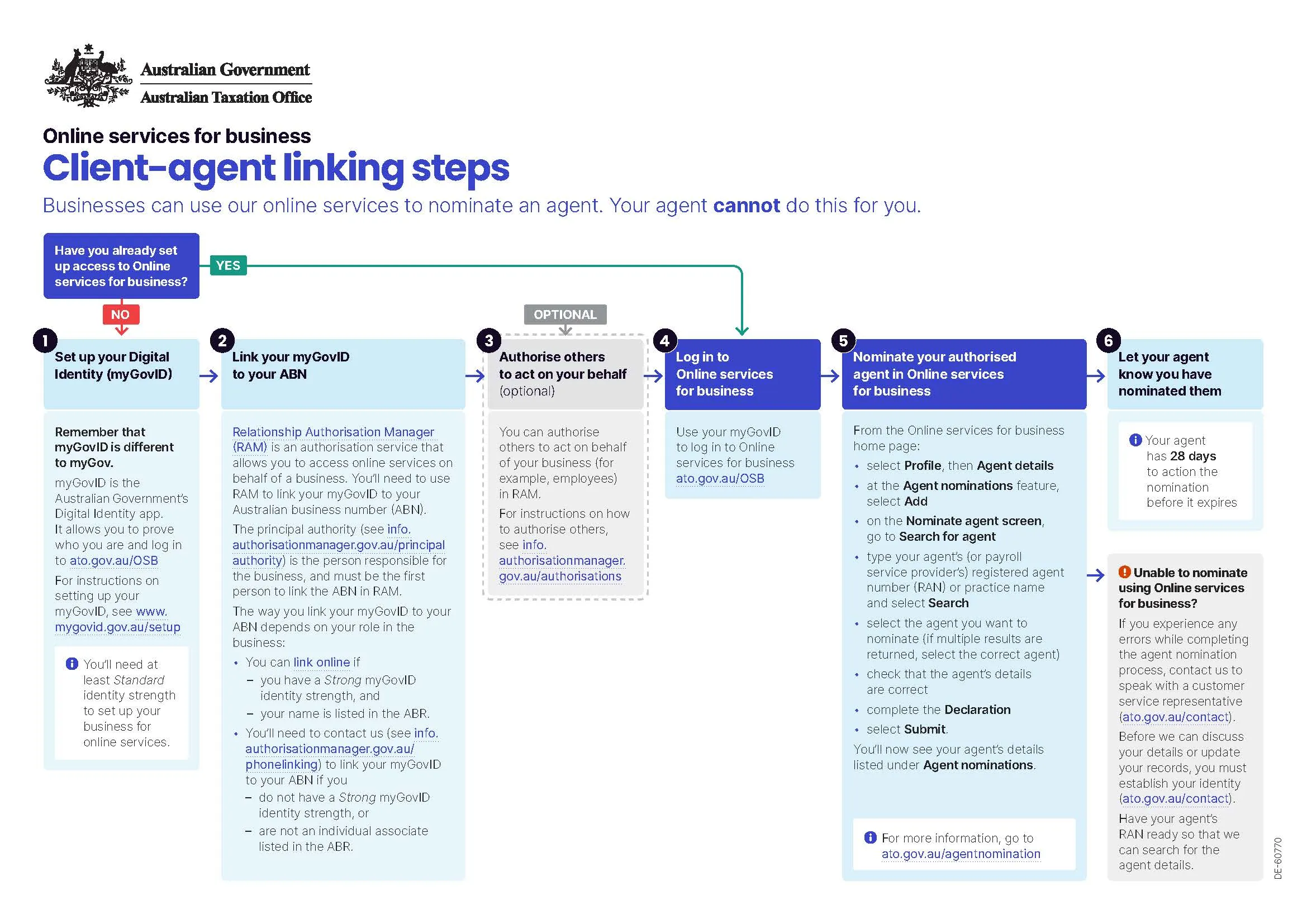
Client-to-agent linking applies to all entity types with an ABN — companies (including strata title bodies), partnerships, trusts, not-for-profits, joint ventures, co-operatives, SMSFs and APRA-regulated super funds. It has applied to all of them since 13 November 2023.
Sole traders, individuals and entities without an ABN don’t need to do this at this stage.
You’ll need to nominate an agent when you:
Two things need to be in place before you can nominate anyone.
1. A myID with at least Standard identity strength. myID is the Australian Government’s digital identity app. It was called myGovID until it was renamed — same app, new name — and it is not the same thing as your myGov account. You can set it up at myid.gov.au.
2. Your myID linked to your ABN in Relationship Authorisation Manager (RAM). RAM is what tells the ATO you’re authorised to act for the business. The principal authority — usually the business owner, director or public officer — must be the first person to link the ABN in RAM.
You can link online if you have a Strong identity strength and your name is listed in the Australian Business Register. If you don’t have Strong identity strength, or you aren’t listed as an individual associate in the ABR, you’ll need to phone the ATO to get linked instead.
The good news: this part is a one-off. Once your myID and RAM access are sorted, you won’t need to do it again.
Once you submit the nomination, we have 28 days to add you as a client before it lapses. If we need longer, you can use the Extend feature in Online services for business, which adds another 28 days from the day you extend.
And if it does expire before we get to it, there’s no penalty and nothing to undo — you simply nominate again.
If you strike an error while completing the nomination, contact the ATO and ask to speak with a customer service representative. You’ll need to establish your identity before they can discuss your details, and it helps to have our RAN ready so they can find us quickly.
Most of the friction in this process is in the myID and RAM setup, not the nomination itself. If you’re stuck at any point, get in touch — we’ll walk you through it, and we’ll give you our RAN so you’re not hunting for it mid-process.
Once the link is in place, we can act on your tax and compliance obligations.
Under the new legislation, since November 2021 all company directors are required to obtain a director identification number (director ID). A director ID is a unique 15-digit identifier that stays with you for life, no matter how many companies you run. It’s free to apply and you only need to apply once.
All new directors must apply for Director ID before being appointed.
How to apply:
The fastest way to get a director ID is to apply online using the myGovID app.
Follow this ABR step by step guide
You must apply for a director ID yourself, unfortunately a Tax Agent cannot do it on your behalf. However, we can always assist you with the process.
If you’re weighing up how your company and trust structure is set up, we can help.
See our services
How we can assist
Speak to a specialist
Reach out to our team online now
Common questions
WhatsApp Us
